
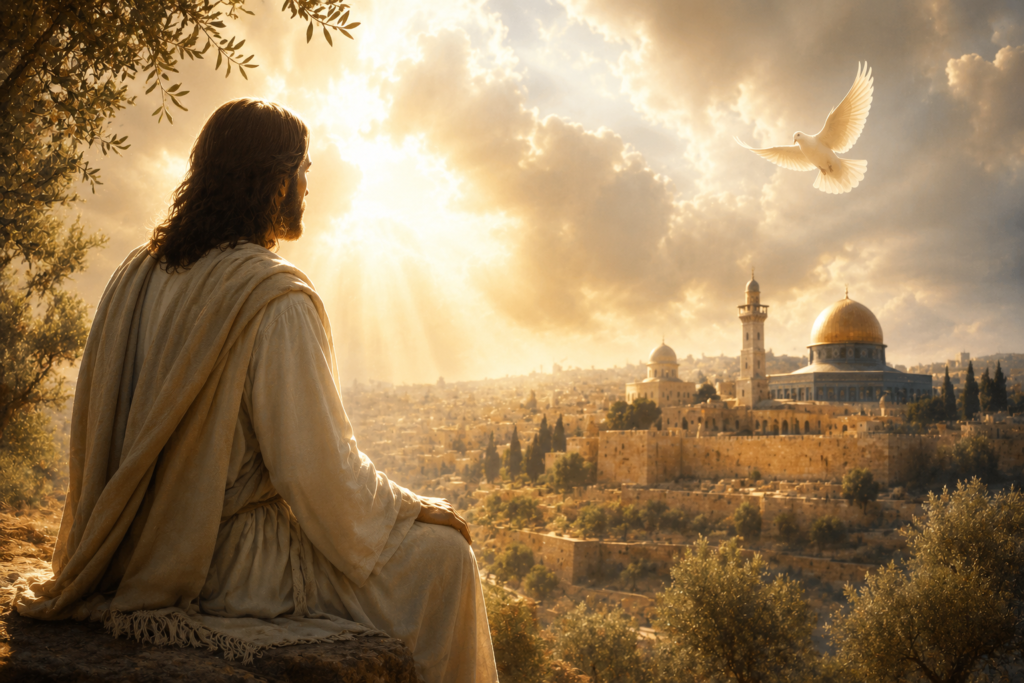
Many people read about Jesus from a Christian point of view and never really look at what Islam says about him. When you miss this, you miss a significant part of understanding both religions and their connection. Without this knowledge, a great deal of confusion remains, and incorrect ideas continue to spread.
According to the Yaqeen Institute for Islamic Research, who Jesus is in Islam is actually a topic covered clearly in the Quran, where he is described as one of the greatest messengers God ever sent. He is honored, respected, and believed in by every Muslim as a true prophet.
Islam does not ignore Jesus at all. It actually speaks of him in great detail, including his birth, his miracles, and his message to people.
If someone grows up thinking Muslims do not believe in Jesus, they will never understand the real relationship between Islam and Christianity. That misunderstanding creates distance that does not need to be there.
This article explains exactly who Jesus is in Islam, who his mother and father were, and who came before him as a prophet.
Who is Jesus in the Islamic religion?
Jesus is known as Isa in Arabic and is highly respected in Islam. The Quran mentions him by name twenty-five times, and he is described as a messenger of God sent to guide the Children of Israel with a new scripture, the Gospel.
Muslims believe in Jesus just as they believe in Moses and Abraham. Islam regards its teachings as a reaffirmation of the teachings of previous faiths, so all Muslims believe in Jesus as a prophet of God.
He is not seen as God or the son of God in Islam. For Muslims, Jesus is neither God nor the Son of God, but he is one of the five greatest messengers, known as the Possessors of Steadfastness.
Who is Jesus, the Prophet in Islam
Jesus was given special titles in the Quran that no other prophet received. He is called the Messiah, the Word of God, and the Spirit, and he was given great miracles as signs of his prophethood and authority.
His miracles included healing the sick, raising the dead, and speaking from the cradle as a newborn baby. According to the Quran, when people questioned his mother after his birth, the infant Jesus spoke and said, “I am indeed a servant of Allah: He has given me revelation and made me a Prophet.”
Islam also teaches that Jesus will return at the end of time. In Islamic eschatology, Jesus will return to establish peace and justice in the world, and he will eventually die a natural death.
Who is Jesus ‘ mother in Islam
Mary, known as Maryam in Arabic, is one of the most honored women in all of Islam. She is the only woman mentioned by name in the Quran, and the nineteenth chapter of the Quran is named entirely after her.
Her status in Islam is not small or ordinary. The Prophet Muhammad listed her among the four greatest women of all time who had reached perfection, and her elevated status is explicitly mentioned in the Quran.
She was chosen directly by God for this role. When the angels said to her, “O Mary, indeed Allah has chosen you and purified you and chosen you above the women of the worlds,” this was a direct honor from God Himself.
Mary gave birth to Jesus without a human father. Muslim scripture, like Christian scripture, regards Mary as having given birth to a miraculous infant son without involvement from a biological father, and Jesus bears similarity to Adam, both created by God’s direct command “Be.”
Who is the father of Jesus in Islam
This is a question many people ask, and Islam has a very clear answer. Jesus had no biological father, and this is not seen as proof of divinity but as a sign of God’s power.
The Quran compares the birth of Jesus to the creation of Adam. Just as God created Adam from dust without any parents, God created Jesus without a father, and this was not an indication of his divinity but of his unique status as a prophet.
Islam teaches that God does not need a partner or a child to do anything. When Mary asked how she could have a son when no man had touched her, Gabriel replied that God only needed to say “Be,” and it was done, and so Jesus came into being.
In Islam, calling Jesus the “son of God” is considered a serious error. The Quran rejects the identification of Jesus as God in order to protect God’s absolute unity, known as tawhid, and Jesus is understood to have preached submission to God’s will and worshipping God alone.
Who is the last prophet before Jesus in Islam
The prophet who came just before Jesus in the Islamic chain of prophethood was Yahya, known in English as John the Baptist. Yahya ibn Zakariyya is considered in Islam a prophet of God who was sent to guide the Children of Israel, and he was the maternal cousin of Jesus.
Yahya was born through a miracle as well, to elderly parents who had no children. The birth of Prophet Yahya can be considered a miracle, as his father, Prophet Zachariah, and his wife were believed to be barren and past childbearing age when they were blessed with him.
His role was to prepare people for the message that Jesus would bring. Yahya was sent to renew the spirit of the religion and support Jesus in his teachings, and he was wise and kind from a very young age.
FAQs
Do Muslims believe in Jesus?
Yes, believing in Jesus as a prophet is required in Islam. A Muslim who denies Jesus as a prophet is considered to have left the fold of Islam.
What is Jesus called in Islam?
Jesus is called Isa in Arabic. The Quran also refers to him as al-Masih, meaning the Messiah, and he is mentioned by name twenty-five times.
Did Jesus die on the cross according to Islam?
No. Islam teaches that Jesus was not crucified. The Quran says it appeared only that way to people, and that God raised him up to Himself.
Who came before Jesus as a prophet in Islam?
Prophet Yahya, known as John the Baptist, came just before Jesus. He was Jesusʼs maternal cousin and helped prepare people for Jesusʼs message.
Is Mary respected in Islam?
Yes, very much so. Mary is the only woman named in the Quran, and an entire chapter is dedicated to her. The Prophet Muhammad named her one of the four greatest women of all time.